Wednesday, 17 October 2012

UCL-Energy seminar: THE MYTH OF APATHY: GOING BEYOND BEHAVIOUR CHANGE - Renee Lertzman, November 20, 2012

UCL Energy Institute

Tuesday, 20 November 2012 from 17:30 to 19:30 (GMT)

London, United Kingdom


Behavior change is fast becoming the holy grail across all environmental sectors. In our quest, we tend to be preoccupied with how we’d know it when we see it (measurements, metrics, observable outputs, profits, sales). However, in the rush to uncover the most effective technology, tool, widget or methodology to help “unlock” this elusive magic box, we seem to be overlooking something quite fundamental. That is, how energy use, climate change and environmental threats are experienced, made sense of, not only cognitively but emotionally and affectively. This seminar presents a new approach, in how Psychosocial Studies can play a significant role in creating innovative and more effective research and practices in meeting our urgent challenges ahead.

About the speaker:
Renee Lertzman teaches Psychology of Environmental Education and Communication in the MA programme at Royal Roads University, British Columbia, and is a psychosocial researcher. She has a PhD in psychosocial studies from Cardiff University, and actively speaks and teaches internationally. Her work has been featured in the New York Times, Nature Climate Change, The Ecologist, Orion Magazine, and numerous publications. Dr. Lertzman actively consults with, and is an invited speaker, to governmental and non-governmental agencies, including the Oregon Global Warming Commission, the BC Ministry of Environment, the EPEAT registry, and environmental organisations.


We expect this event to be extremely popular, and places will be on a first come first served basis. If you are no longer able to attend please email e.jones@ucl.ac.uk
The presentation will promptly start at 5.30pm and will be followed by drinks and nibbles and the opportunity to network.

http://www.bartlett.ucl.ac.uk/energy/events/renee-lertzman
http://reneelertzman.eventbrite.com/
 http://www.reneelertzman.com/

Engaging with Climate Change Psychoanalytic and Interdisciplinary Perspectives (Weintrobe 2012)

This book grew out of the conference of the same name held in London in 2010. Here is the link to videos from the conference of the main papers which went on to form the book. This represents the widening of the engagement between psychoanalysis and climate change and related fields. Sally Weintrobe's (2012) edited book is therefore essential reading and crucial to the development of ecopsychoanalysis. A book review is to follow soon.


Engaging with Climate Change

Psychoanalytic and Interdisciplinary Perspectives

Edited by Sally Weintrobe

Published 20th September 2012 by Routledge – 280 pages

How can we help and support people to face climate change?

Engaging with Climate Change is one of the first books to explore in depth what climate change actually means to people. It brings members of a wide range of different disciplines in the social sciences together in discussion and to introduce a psychoanalytic perspective. The important insights that result have real implications for policy, particularly with regard to how to relate to people when discussing the issue. Topics covered include:
  • what lies beneath the current widespread denial of climate change
  • how do we manage our feelings about climate change
  • our great difficulty in acknowledging our true dependence on nature
  • our conflicting identifications
  • the effects of living within cultures that have perverse aspects
  • the need to mourn before we can engage in a positive way with the new conditions we find ourselves in.
Through understanding these issues and adopting policies that recognise their implications humanity can hope to develop a response to climate change of the nature and scale necessary. Aimed at the general reader as well as psychoanalysts, psychotherapists and climate scientists, this book will deepen our understanding of the human response to climate change.

http://www.routledge.com/books/details/9780415667623/ 


Making connections: psychoanalysis, ecology and deleuze and guattari's philosophies

Psychology in Society

Psychol. Soc.  no.42 Cognella  2011,  ISSN 1015-6046

Maria Tamboukou
Centre for Narrative Research University of East London London England


Ameobas gather into a colony

Dodds, Joseph (2011) Psychoanalysis and ecology at the edge of chaos: Complexity theory, Deleuze / Guattari and the psychoanalysis for a climate in crisis. New York & London: Routledge. ISBN 978-0-415-66612-1 pbk. Pages 238. 

As its title flags up, Psychoanalysis and ecology at the edge of chaos makes a significant contribution to current discussions around the ecological crisis by suggesting that psychoanalysis offers important insights in the problem of climate change and its effects. Now this might initially look like a difficult argument to grasp, but the challenges that the author Joseph Dodds presents us with do not stop here; the second important argument of the book is that psychoanalytic thinking is compatible with and complimentary to Deleuze's and Guattari's philosophies. Two plateaus of challenging suggestions and analyses then that I will try to unfold in this review. 

The book comprises fourteen chapters, structured in four sections. Section One, Climate change, sets the context of the inquiry by looking into the Climate crisis (Chapter One) and the Theoretical crisis (Chapter Two), while the third Chapter, Ecology at the edge of chaos synthesizes the two previous crises by flagging up the imminent danger of failing to address the planetary crisis both on a materialistic and discursive level. What stands out in this section is the author's argument that the climate change is a psychological problem, as well as a social, political and economic one, and although it has been addressed in certain fields of psychology, it has yet to be registered in the psychoanalytic literature. It is precisely this gap that the book is attempting to fill and it does so by drawing on an extensive research project that spans a number of years as well as a range of disciplinary areas including psychology, psychoanalysis, social theory, critical geography, philosophy and cultural studies. It is no wonder that Ecopsychoanalysis emerges as a neologism of the overall research project of which the book is a part.

Having made the argument about the relevance of psychoanalysis in the ecological discussions and debates, Section Two excavates the field of psychoanalysis to nuance and support the argument of its close connection to "environmentalism and its discontents" (p. 27). Chapter Four takes up Classical psychoanalysis, as a disciplinary ground for "a psychoanalysis of ecology", by drawing on Freud's discussion of civilization, nature and the dialectic of the Enlightenment, while bringing in Deleuze's and Guattari's critique as well as nuanced discussion of it. Dodds argues that Deleuze and Guattari knew much more about psychoanalysis than many contemporary Deleuzians (xiv) and there is therefore a need to reread Anti-Oedipus in the light of Deleuze's and Guattari's interest in ecological questions. Apart from its nuanced discussion of philosophical concepts, including eros and thanatos, the author considers "the rise of the eco-disaster film" thus bringing in cultural film theory in his theoretical and methodological toolbox. Chapter Five deals with the problem of "eco-anxiety" and defence, drawing illuminating analogies with classical psychoanalytic concepts. The chapter particularly highlights the role of humour in media representations of a series of defence arguments against the ecological threat and draws on the Lacanian notion of symptom as a way to theorize the role of the media in these debates. His main argument is that although psychoanalysis cannot offer a material solution to the ecological problem, it can nevertheless facilitate understanding not just of the problem but more importantly perhaps of our failure to conceptualize the critical dangers it poses and the importance of co-ordinating a multi-levelled response. Chapter Six considers object relations theory as a particularly useful psychoanalytic field in the process of understanding our relation to Earth and the way we respond (or not) to the needs and expressions of the non-human world. The human addiction to consumerism is particularly considered here, while the paranoid-schizoid position offers according to the author a useful framework within which to understand our failure to engage with the severity of the ecological crisis.

The ecology of phantasy becomes the central theme of Section Three, which more particularly deals with the possible interventions of psychotherapy in the area of the ecological problem as already charted in the previous sections. Chapter Seven particularly discusses what the author identifies as "the greening of psychotherapy", looking into the dualism of biophilia and biophobia and considering the possibility of "liberating the ecological unconscious" or at least opening up paths for its traces to be discerned. Dodds further looks into connections between what he defines as "developmental ecopsychology and climate change" and finally brings forward the argument of "ecotherapy" as a contribution of "ecopsychology" to questions of health and wellbeing. Chapter Eight makes a critical post-modern transition by positing the possibility of an "ecology without nature" and by "deconstructing the ecological imagination." The chapter then turns to Deleuze's and Guatatri's image of geophilosophy, as well as the critical links between psychoanalysis and schizoanalysis. There is no way to write about Deleuze and Guattari without referring to their often misunderstood concept of becoming-animal, and this is what Chapter Nine does, bringing in literary and cultural studies' perspectives, through a discussion of the Bakhtinian carnivalesque and a Deleuzian analysis of horror films. This prepares the ground for the last chapter of Section III, which deals with "the zoological imagination" thus completing the phantasy themes that are interwoven in this post-structuralist section.

In a concluding mode, the last section deals with complexity theory as a matrix encompassing the very diverse areas that the book has brought together by making rhizomatic connections between and amongst them. Chapter Eleven explores possibilities for research and thinking in a non-linear world and considers questions of chaos, contingent emergencies and non-linear dynamics. Chapter Twelve examines connections between psychoanalysis, ecology and complexity through the Deleuzian concepts of coevolution and nomadic subjectivities. Chapter Thirteen looks into the ecology of mind, non-linear temporalities as well as De Landa's reconfiguration of Deleuze and Guattari's assemblage theory as a new science of society, while Chapter Fourteen concludes the study by returning to the neologism of ecopsychoanalysis.

What I enjoyed most in this book is the clear way that Joseph Dodds presents and explicates a range of theoretically dense concepts and the innovative way he synthesises them in building and developing his overall thesis. I also appreciated the nuanced way that both psychoanalysis and schizoanalysis are being presented, discussed and juxtaposed, since there is a tendency in Deleuzian studies to refute complex psychoanalytic concepts by naive simplifications and crude reductions. Dodds persuasively shows that there is much more in psychoanalysis than some over excited Deleuzians are willing to admit and there is indeed worth looking carefully into both fields to unravel unseen and yet productive connections. As a reader I was further persuaded about the usefulness of a psychoanalytic reading of contemporary questions and issues around the planetary crisis. Having mostly enjoyed the book I have to say that I was not impressed by the discussion around complexity. I feel that the author should have brought in some of the interesting debates around complexity in social theory today, so chaos is in my view the only strand of the argument that could have been developed more. Overall however, this is a very useful and interesting book, carefully researched, well organized and clearly written, a very good case of truly interdisciplinary scholarship.


Wednesday, 13 June 2012

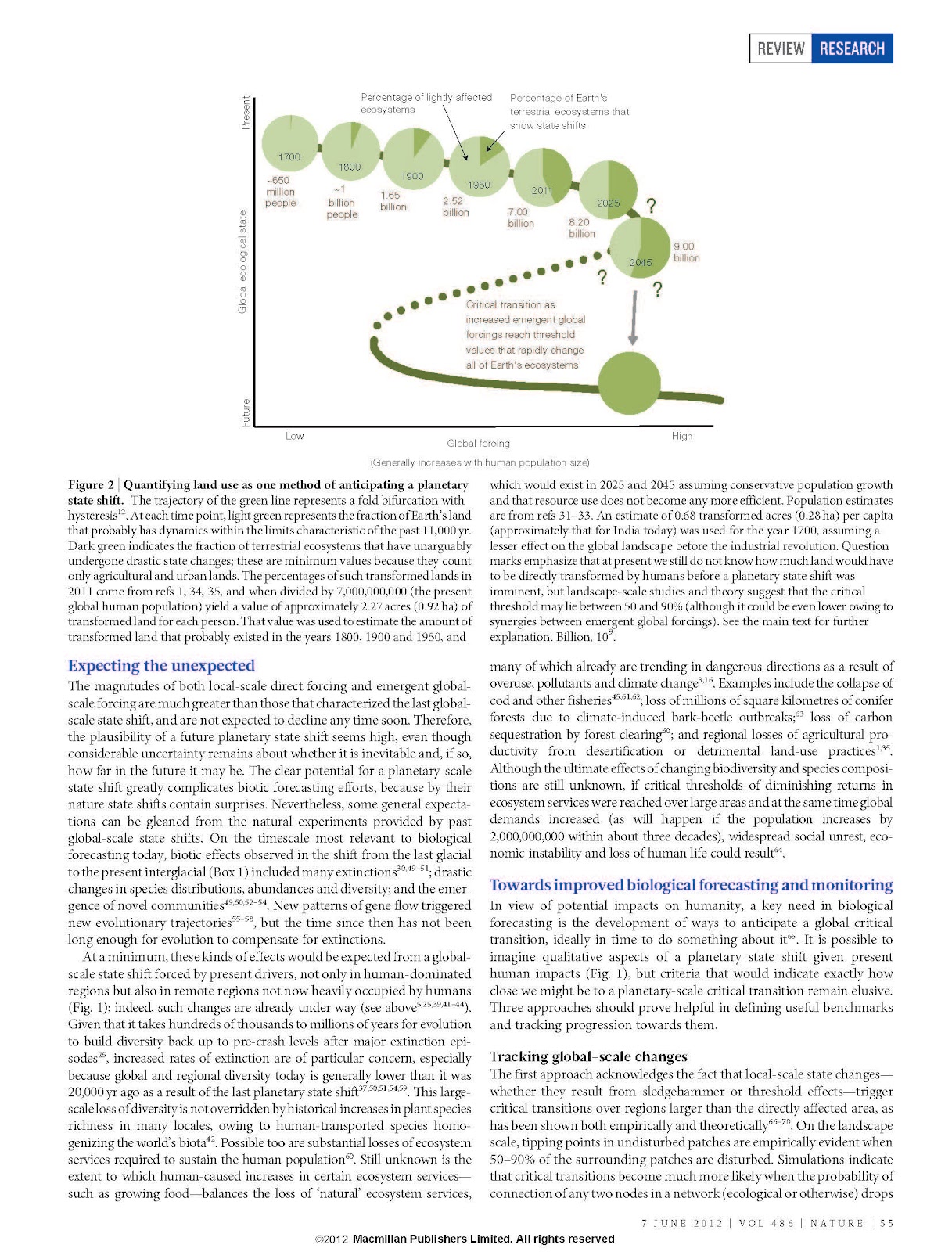
Approaching a State Shift in Earth’s Biosphere


Below is a very important new paper from Nature. http://www.nature.com/nature/journal/v486/n7401/full/nature11018.html See also the full pdf: http://t.co/JziBOk4o

It underlies more clearly the various nonlinear effects, fold bifurcations, hysterisis, and state shifts (both 'threshold' and 'sledgehammer') involved in the ecological crisis. We need a state shift in mental and social ecologies, and for them to occur sooner than the predicted global collapse in natural ecologies, which appear to be reaching self-organised criticality.  


Monday, 4 June 2012

Derrida, Deleuze, Lacan and Žižek on Animality (Videos and Discussions)

Having just discovered Derrida's (2008) The Animal That Therefore I Am, I posted Christopher Higg's notes/review in the previous post. Here are two more: And Say The Animal Responded– A Response (Fragments, 2011), and Animal Tracks (Kari Weil, H-Animal, 2008) plus a video of Derrida discussing the question of 'the animal'.


We can compare this to Deleuze's 'A is for Animal'. See text here: See also this discussion on the status of animality in Deleuze's thought from Alain Bealieu (2011)


Both Derrida and Deleuze were to some extent engaging with and critiquing Lacan's position, some of which is captured in this video (especially at the start).


In this recent talk in Berlin (2011), Žižek engages with both Derrida and Lacan, specifically with Derrida's 'The Animal Which Therefore I Am' discussed above, as well as Žižek's usual heterogenous mix of concerns. Žižek's talk has been contrasted with his previous description of vegetarians as 'degenerates'. See for example Northern Song.

Sunday, 3 June 2012

Derrida’s The Animal That Therefore I Am (Higgs 2010)

http://htmlgiant.com/random/notes-on-derridas-the-animal-that-therefore-i-am/ 

Notes on Derrida’s The Animal That Therefore I Am (Higgs 2010)


Published in French in 2006, two years after his death, this book is a long lecture (which actually turned into a ten-hour seminar) that he wrote for the 1997 Cerisy conference on his work titled “The Autobiographical Animal.”
Here Derrida sets his sights on the philosophical problematic of the animal. Specifically, he is interested in exploring the limits of that interstitial space between that which we call animal and that which we call human. He coins the neologism “Limitrophy” to describe this exploration, “Not just because it will concern what sprouts or grows at the limit, around the limit, by maintaining the limit, but also what feeds the limit, generates it, raises, and complicates it. Everything I’ll say will consist, certainly not in effacing the limit, but in multiplying its figures, in complicating, thickening, delinearizing, folding, and dividing the line precisely by making it increase and multiple.” (29) He predicates this line of inquiry on his assertion that the entire history of philosophic discourse from Aristotle to Heidegger is guilty of misrepresenting or misinterpreting the basic ontological difference between that which we call animal and that which we call human.

He opens with a discussion of the Genesis myth, focusing on the way in which Adam is naked in the garden until he eats the fruit from the tree of knowledge. Instead of the typical reading of this action as a fall from grace, Derrida sees this as the inciting incident for the creation of humanity. Recognition of nudity, and the shame associated with it, is particularly interesting to Derrida because, as he puts it, “In principle, with the exception of man, no animal has ever thought to dress itself. [Thus] clothing would be proper to man, one of the ‘properties’ of man. ‘Dressing oneself’ would be inseparable from all the other figures of what is ‘proper to man,’ even if one talks about it less than speech or reason, the logos, history, laughing, mourning, burial, the gift, etc.” (5) These “properties of man” are the sites he wants to push against in this lecture.


In his trademark elliptical, recursive, persistently deferring style, he raises this issue of being naked in front of that which we call animal, what it means to be naked, how that which we call animal cannot be naked, what it means to be seen by that which we call animal, and what it means for a human to see themselves in the eyes of that which we call animal.

N.B. this phraseology “that which we call animal” instead of the simpler term “animal.” This is purposeful. For Derrida, the fact that we refer to all living creatures that are not human as “animals” is absurdly reductive. He makes a good point. Lumping together the cricket and the whale, the mountain lion and the parakeet, the giraffe and the marmot, seems lazy and dismissive, yet, as Derrida points out, this is exactly what philosophers from Aristotle to Heidegger are guilty of doing. And part of his project is to shine a light on this unexamined assumption.

Take Heidegger, for example. As Derrida shows, Heidegger delineates three ontological positions: the living being (which is separated into the animality of the animal and the humanity of the human) and the nonliving being. So, for Heidegger, you are either a nonliving being (the example he uses is a stone) or a living being, of which there are only two kinds: animal and human. According to Heidegger, the determining distinction between the animal and the human is the ability to die. Animals, Heidegger argues, come to an end but do not die. By the same token, “A dog does not exist but merely lives.” Humans, on the other hand, have “the living character of the living being,” by which he seems to mean logos and/or the awareness of mortality and/or the ability to manipulate existence and/or the ability to choose death. Heidegger’s specific wording for these distinctions are, “the stone is wordless, the animal is poor in the world, man is world-forming.” Of the various objections Derrida raises to Heidegger’s argument, the one that resonates most powerfully with his project of limitrophy is his assertion that the binary division between human and animal falls vastly short of representing the multiplicity of difference between various species. (On a personal note: I read Derrida’s argument regarding the need to move beyond the univocal signifier “animal” as akin to the annoying error so often made when someone generalizes about “Africa”: not taking into account the immense geographic, historic, political, social, and cultural diversity of the continent.)

Another site for Derrida’s limitrophy is Lacan’s position vis-à-vis the difference between that which we call human and that which we call animal. For Lacan, it should be no surprise, what separates the two is language. It is a difference between response and reaction. Animals, Lacan argues, do not respond to questions; they react to stimuli. They do not have a language, rather, they use a coded system of signaling, which is a fixed program, as opposed to the dynamic, symbolic interaction of the human. He uses bees as an example: the dance of the bee who returns to the hive to direct others to where they might find nectar. Lacan claims that this dance is not an exchange in need of interpretation, as would be the case with humans, but is instead a kind of exchange of data from one (as Derrida puts it) Cartesian machine-animal to another Cartesian machine-animal. For the most part, Derrida is not as interested in refuting Lacan’s claim as much as he is interested in making porous the distinctions, again, exploring the limits, the threshold between response and reaction.

In terms of application, Derrida’s idea of limitrophy is of particular interest to me as a potential guiding methodology for exploring the posthuman (one of my current fields of inquiry) – and more specifically, for my major ongoing research interests, as a way to think and talk about experimental literature. If posthuman discourse can, in some ways, be considered an exploration of the categorical boundary separating the human from the non-human, I don’t see why that discourse can’t be grafted onto a discussion of the categorical boundary separating conventional realism and non-conventional realism.  Aren’t both programs reliant on the power engendered by the exclusivity of their (perceived) unique characteristics in order to demarcate them as foundational, separate, autonomous, sovereign? In other words, that which we call human seems analogous to that which we call conventional realism.  Perhaps, as posthuman discourse shows us the inherent flaw in such molar classification of the human, so too can this discourse show us the inherent flaw in conceiving of conventional realism as a molar classification.  Both that which we call human and that which we call conventional realism are porous, malleable, molecular — while at the same time they seem to present legible boundaries. Limitrophy offers a strategy for questioning the validity of those perceived boundaries by identifying gaps, spaces, discontinuities, through surveying the interstitial space between that which constitutes and that which deviates.

Friday, 1 June 2012

Engaging with Climate Change, Psychoanalytic Perspectives Conference Videos (Oct, 2010, Institute for Psychoanalysis, London, UK)

How does our knowledge of climate change affect our sense of identity? What might underlie issues of connection with, and disconnection from, the natural world? How do we understand the denial of climate change?

Speakers from the field of psychoanalysis explore these and other questions with scientists, environmentalists, writers, educationalists and policy makers. The conference aims to achieve a better understanding through interdisciplinary exchange. Click here to email us a question for the event.

1. "Great Expectations: some psychic consequences of the discovery of personal ecological debt", Rosemary Randall, with discussants Margaret Rustin and Bob Ward. Followed by a general discussion


2. "The myth of apathy", Renee Lertzman, with discussants Irma Brenman-Pick and Erik Bichard.


3. "Different structures of feeling in relation to the natural world", Michael Rustin, with discussants Jon Alexander and Ted Benton. 

 4. "Unconscious obstacles to caring for the planet", John Keene, with discussants Michael Brearley and Bob HInshelwood.

 5. "Engaging with the natural world and with human nature", Sally Weintrobe, with discussants Tom Crompton and Mike Hannis. 

6. "Climate change denial in a perverse culture", Paul Hoggett, with discussants Stanley Cohen and John Steiner. Followed by a general discussion.

7. Book launch: "Engaging With Climate Change: Psychoanalytic and Interdisciplinary Perspectives"

Why Science Education Won't Solve Our Climate Problems

Why Science Education Won't Solve Our Climate Problems

Important! But not the solution to climate change. 

Think the reason we can't address climate change is because people don't understand climate science? Think again: a new study suggests that people with higher scientific comprehension use their abilities not to disinterestedly parse the complicated details of climate science, but to better fit available evidence to their preexisting values and group identifications. A team of researchers associated with the Cultural Cognition Project at Yale Law School compared scientific literacy and numeracy with beliefs about climate change and value-laden worldviews for an article published this week in Nature Climate Change. Their conclusions? As individuals' scientific comprehension went up, concern about climate change declined slightly. That relationship isn't what you'd expect to see if ignorance about science explained a lack of concern about climate change, as the "scientific comprehension thesis" (SCT) would suggest; the graph below demonstrates the difference between what SCT predicts and how people actually responded.
SCT prediction versus actual impact of science literacy and numeracy on climate change risk perceptions.  Kahan et.al, Nature Climate ChangeSCT prediction versus actual impact of science literacy and numeracy on climate change risk perceptions. Kahan et.al, Nature Climate Change

But not everyone with greater scientific understanding was equally likely to be less concerned about climate change; the correlation split sharply depending on respondents' worldviews. As the study explains, "members of the public with the highest degrees of science literacy and technical reasoning capacity were not the most concerned about climate change. Rather, they were the ones among whom cultural polarization was greatest." While those results don't jibe with the SCT, they do make sense according something called the cultural cognition thesis (CCT), which suggests that people tend to perceive risks in a way that corresponds to the values of their identity groups.

Think about it: An oil worker who expresses concern about climate change may be mocked, while an English professor who calls climate science a hoax may be shunned. People therefore adjust their beliefs to fit those of others around them: according to the study, "public divisions over climate change stem not from the public’s incomprehension of science but from a distinctive conflict of interest: between the personal interest individuals have in forming beliefs in line with those held by others with whom they share close ties and the collective one they all share in making use of the best available science to promote common welfare." Or, as researcher Ellen Peters of Ohio State University puts it, "What this study shows is that people with high science and math comprehension can think their way to conclusions that are better for them as individuals but are not necessarily better for society."

More specifically, people with what the study identified as a "hierarchical individualist" worldview—one that values top-down authority—tended to see climate change as less of a risk as their scientific literacy and numeracy increased. On the other hand, people with an "egalitarian communitarian" worldview—one favoring "less regimented forms of social organization and greater collective attention to individual needs"—tended to perceive climate change as a greater risk as they gained scientific comprehension.
SCT prediction versus actual impact of the interaction between science literacy and numeracy, on the one hand, and cultural world-views, on the other.  Kahan et.al, Nature Climate ChangeSCT prediction versus actual impact of the interaction between science literacy and numeracy, on the one hand, and cultural world-views, on the other. Kahan et.al, Nature Climate Change

In short, when it comes to climate change, people tend to accept or reject scientific information based upon whether it threatens or supports their existing values and relationships, and the effect is stronger among those who are better able to understand the implications of that information for their values. The researchers' conclusions suggest that climate change is fundamentally a political issue, not simply a technical problem or information gap. They also suggest that green-minded efforts to educate climate change deniers in hopes of getting them to change their views are naive at best.
People who don't believe in climate change aren't merely ignorant, uneducated, or anti-science; on the contrary, many of them are actually pretty good at assessing their (at least short term) interests and evaluating threats to them. That means we can't ignore the political and value questions associated with climate change—any strategy that assumes everyone with adequate scientific education will reach the same conclusions is doomed to fail.

The study's lead author, Dan Kahan, a law professor at Yale, thinks that information about climate has to do more than simply communicate "the facts": rather, it has to "create a climate of deliberations in which no group perceives that accepting any piece of evidence is akin to betrayal of their cultural group." In other words, people have to feel that being concerned about climate change won't result in them becoming ostracized by their social groups. The study suggests that it may be effective to use "culturally diverse communicators" who have credibility in different communities and are able to talk about climate change in less threatening ways. (In other words, don't expect Al Gore to convince Rush Limbaugh listeners to care about climate, no matter how good his graphs are.)

But those kinds of communicators are few and far between; Fox News, for example, is already spinning the study's findings to validate climate denialism. Moreover, while better communication might help reach some people, what happens when climate solutions actually do present a threat to certain worldviews and values, as some certainly will? This study doesn't answer those questions. But it does suggest that some of the dominant narratives about why we aren't dealing with climate change are lacking.