Two new studies point towards the interesting interaction between
psycho-social taboo’s, belief systems, social practice and ecological effects
on species survival and biodiversity.
The first is a
rather tragic example of how psycho-social-cultural shifts can have major
ecological effects. In particular that ideas
and beliefs (via their effects
on local mental ecologies and then social ecologies) can be devastating on
local flora and fauna (natural ecologies). Here we see the ecopsychoanalytic use of Guattari’s three
ecologies of mind, society and nature as nonlinear interlocking dynamical
systems of mutual contingencies.
Madagascan lemurs endangered by eroding taboos
Madigascar is one of
the most ecologically important places on Earth. An ancient island which split
from the Gondwana supercontinent 165 million years ago, it is a biodiversity
hotspot (over 95% of its plants and animals cannot be found anywhere else)
which sometimes leads it to being described as the ‘eighth continent’.
Jenkins et al (2011) write that:
Taboos have
provided protection to some species, particularly the Endangered Indri, but we
present evidence that this taboo is rapidly eroding. By considering a variety
of potential influences on consumption in a single study we have improved
understanding of who is eating bushmeat and why... The erosion of traditional
cultural taboos in Madagascar has led to an unsustainable number of lemurs
being killed for bushmeat...Some species do not reach
maturity for up to nine years and produce offspring once every two or three
years...Primates, in general,
are known to be extremely vulnerable to overexploitation.
Christopher Golden, from the
Harvard Center for the Environment, US, said the island nation had a rich
natural heritage. "If you look at the
mammals especially, which are the main group of animals affected by the
bushmeat trade, all the primates - 100% of them - are unique to the island.
They suggest the rise in
illegal hunting is due to rapid social change (partly due to gold mining),
increased demand for meat and lack of alternatives, and importantly a decline in
traditional taboos: "When you have globalisation and outside influences,
traditional cultures break down and change faster."
What are these taboos?
There are several traditions explaining these. One tells of an Indris Lemur who
saved a man falling from a tree while collecting honey. Other beliefs include
the idea that they are ancestors that became lost in the rainforests and turned
into lemurs to survive.
What does this
have to do with psychoanalysis?
As we know
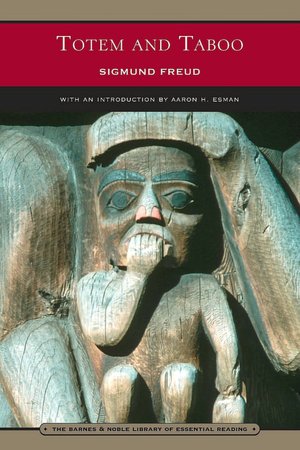
Freud wrote a whole book on taboo (and totemism),
and looking at these taboos
may not only have practical consequences on the eco-psycho-social system
of
places such as Madigascar, but may also help us explore ourselves and
our relationship with
the nonhuman world. In particular we can explore the connection Freud
suggested between animal totemism and animal phobias in childhood,
starting with Freud's famous patient, now best known as the 'wolfman':
I dreamt that it was night and that I was lying in
bed. (My bed stood with its foot towards the window; in front of the window
there was a row of old walnut trees. I know it was winter when I had the dream,
and night-time.) Suddenly the window opened of its own accord, and I was
terrified to see that some white wolves were sitting on the big walnut tree in
front of the window.
There were six or seven of them. The wolves were quite
white, and looked more like foxes or sheep-dogs, for they had big tails like
foxes and they had their ears pricked like dogs when they pay attention to
something. In great terror, evidently of being eaten up by the wolves, I
screamed and woke up. My nurse hurried to my bed, to see what had happened to
me. It took quite a long while before I was convinced that it had only been a
dream; I had had such a clear and life-like picture of the window opening and
the wolves sitting on the tree. At last I grew quieter, felt as though I had
escaped from some danger, and went to sleep again. (Freud 1918)
In Freud's Bestiary: How Does PsychoanalysisTreat Animals? Genosko (1993) explores this area in some depth and uses Deleuze and Guattari's critique of
Freud to open up a what he calls a 'zoological vision' for psychoanalysis. He
notes that Freud's interpretation of the scene in the wolfman’s dream depicted in
the painting below, involves a reversal so that it is the (human) child “who
takes the active position while other nonhuman animals assume the passive role of
being looked at” (Genosko 1993, 614).
We could see this move as representative of the repression of the
ecological unconscious in Western culture, as “Freud initiates a
unidirectional communication appropriate to the collector: animals are
exhibited, mounted or unmounted, in display cases...a full-blown domestication
of the scene” by which the “gaze of the other is emptied... becoming an
unseeing look like that of zoo animals, objects for our inspection” (Genosko
1993, 614).
Animals stalk the pages of Freud's other case histories too. Erst Lehrs
had his own 'becoming-animal' by being transformed through his case history into
the 'Rat Man'. He was also given the nickname 'corpse-bird', and Freud in
addition labelled him “an osphresiolagniac, a snooping and sniffling dogchild” (Genosko
1993, 603). Freud himself is well known for his love of dogs.
 Werewolves and civilization
Barbara Creed (2005, 123), in Phallic Panic: Film, Horror and the Primal Uncanny, argues that in his description of the Wolf-Man, “Freud focused
too much on his own phantasy of the castrating paternal figure and not enough
on his fearful folkloric con, the wolf-man in sheep's clothing.” Deleuze and
Guattari (2003a, 38) in their book A Thousand Plateus: Capitalism and Schiophrenia (in their Chapter '1914: One or Several Wolves?') hold a similar position when they write that “The trap was
set from the start...Talk as he might about wolves, howl as he might like a
wolf, Freud does not even listen; he glances at his dog and answers, 'It's
daddy.' ”
This is true of Freud's work more generally, where both animal
totems and animal phobias involve according to Freud (at least for the boy) a substitute for the (Oedipal) father. In 'The Return of
Totemism in Childhood' in Totem and Taboo Freud (1913a, 187; quoted in Genosko 1993, 608) claims that animal phobias are “a very common, and perhaps the earliest, form of psychoneurotic
illness occurring in childhood”.
For Freud, the “ambivalent attitude (to obey and transgress) toward the
two principal taboos of totemism” (Genosko 1993, 608) is identical to “the
primal wishes of children and the two crimes of Oedipus”. By displacing anxieties relating to the father onto an
animal substitute, the animal turns into an object of both fear and
fascination, such as Little Arpad's chickens (Ferenczi 1952), and Little Hans'
horse.
Hans identified with his father by becoming a horse, trotting around the
household, neighing, wearing a nosebag, and, finally, by biting his father and
behaving in a fearless way toward him (Freud, 1909a, 213-214)... Ferenczi's
'Little Chanticleer' expressed that he had become a chicken in numerous
ways...cackling and crowing...singing songs with chicken themes, play[ing] with
toy fowls by 'slaughtering' and 'caressing' them. (Genosko 1993, 608)
Creed (2005, 130) connects the totemism described by Freud to the cannibalism
theme of the werewolf myth, where she suggests that “Through metamorphosis and
cannibalism, the wolf-man points to the 'instability of the paternal metaphor'
and the failure of civilization”. For Creed, “the cannibal meal of the wolf-man
myth symbolizes a pact not with civilization but with nature and wilderness.”
The wolfman is an uncanny creature of the inbetween,
being neither man nor beast, and belonging to neither city or forest while
dwelling in both. Therefore, the werewolf, as
myth, as film motif, and as patients' phantasies and phobias refers not simply
to the return of repressed desires which the City has blunted and eroded, but
rather:
...the
wolf-man signifies those indeterminate, uncanny animal spaces necessary
to the creation and definition of their opposite: the familiar,
civilized human city. The wolf-man does not leave the town or city to
live in exile in the forest; he is compelled to live as an exile within
the city...he engages in a modern reworking of murder and the totem meal
which celebrates not the emergence of civilization but its end (Creed
2005, 133).
This theme is explored in more depth (and its relation to the becoming-animal of horror films) in my book (in chapter 10: Becoming-Animal and the Zoological Imagination). From an
ecopsychoanalytic perspective one important aspect of Freud's descriptions of
animal phobias is an implicit suggestion that psychological health involves
overcoming such ambivalences, enabling a return to the previously 'excellent
relations' with animals. Freud (1913a, 187) writes that sources for animal phobias
are both 'textual', where animals are “only known to the child from picture
books and fairy tales” and 'contextual' through direct contact, depending on
the geographical location of the child: “horses, dogs, cats, less often birds,
and with striking frequency very small creatures such as beetles and
butterflies”.
Freud...said
little about prephobic relations except that children identify strongly with
nonhumans...seen as “full equals”...he showed little interest in the positive
relations that may again obtain between children and animals after a successful
analysis...it was not only that Hans “ceased to be afraid of horses.” Rather,
he recovered the pleasure that they gave him and the wonder they inspired... Psychoanalysis...[has]
a certain unrealized potential in reconstituting the relations between children
and animals (Genosko 1993, 610)
At the heart of Deleuze and Guattari's (2003a, 240) critique of Freud
is their claim that “the only kind of animals that psychoanalysis understands
are individuated animals, family pets, sentimental, Oedipal animals each with
its own petty history, ‘my’ cat, ‘my’ dog.” For them, Freud could not allow the
Wolf-Man to become Wolf and join the pack but instead worked to 'Oedipalize'
the Wolf-Man's animal becomings, rather than recognising that “every animal is
fundamentally a band, a pack” (Deleuze & Guattari 2003a, 239).
Tiger bone in your wine sir?
 All
this might
lead us to want to look beyond the confines of 'cannibalistic' western
culture, and seek for wisdom in the traditions of the ‘indigenous’ and
the ‘non-Western’ but this simple dualism is highly problematic as I
discuss in chapter 7 of my book: 'Ecopsychology and the Greening of Psychotherapy'.
As Freud wrote, the flip-side
of the taboo against consumption of the totem animal is a strong desire for
this permitted on socially prescribed feasts, including the Christian communion
where the congregation collectively eats the body and drinks the blood of Christ,
as well as the infantile experience of feeding at the breast where one devours
what one loves.
All
this might
lead us to want to look beyond the confines of 'cannibalistic' western
culture, and seek for wisdom in the traditions of the ‘indigenous’ and
the ‘non-Western’ but this simple dualism is highly problematic as I
discuss in chapter 7 of my book: 'Ecopsychology and the Greening of Psychotherapy'.
As Freud wrote, the flip-side
of the taboo against consumption of the totem animal is a strong desire for
this permitted on socially prescribed feasts, including the Christian communion
where the congregation collectively eats the body and drinks the blood of Christ,
as well as the infantile experience of feeding at the breast where one devours
what one loves.
What are the most
forbidden animals for in Western culture to eat today? The most taboo animals would have
to be the most endangered species, especially the large fauna so beloved of
conservation charities, like tigers (the interesting exception here might unfortunately be
our cherished ‘Oedipal’ pets, our dogs and cats, as for many we would be more
upset at the death of ‘our’ pet than the annihilation and extinction of an entire
species).
“With an ingredients list
that includes rhino horn and tiger bone, traditional Asian medicine is on a
collision course with wildlife preservation. The rhino and its horn [used to
treat everything from fever to AIDS, cancer and brain haemorrhages] are
not alone: powdered tiger bone is used to treat rheumatism; the scales of the
toothless, anteater-like pangolin are believed to reduce swelling and improve
blood circulation; and guilinggao, a jelly derived from the shells of
freshwater turtles, was used to treat smallpox in a nineteenth-century emperor,
with little success — in Taiwan it is now reputed to cure cancer. It is a
similar story for many other endangered species whose commercial use is
restricted — or banned outright — by the Convention on International Trade of
Endangered Species of Wild Fauna and Flora (CITES).”

These damaging practices are
now combining with the dramatically rising wealth in China to form a new demand
for high status consumables such as using tiger bone in wine and shampoo, and
tiger penis soup.
The illicit trade in
wildlife is a booming industry, estimated by the US congressional research
service to be worth as much as US$20 billion globally
each year.
Although this figure includes trade in bushmeat, skins and exotic pets, in the
expanding Asian market, estimated to be the largest in the world, a significant
driver is traditional Chinese medicine (TCM). Indeed, despite showing signs of
decline in the 1990s, the poaching and trade of endangered animals such as
tigers and rhinos is once again on the rise…
One likely factor driving
this demand is the rise in the wealth of China, says Sabri Zain, director of
advocacy for Traffic International in Cambridge, UK, which was established in
1973 to monitor wildlife trade. “Currently China is the biggest market,” he
says. This dominance is not just a consequence of China's population, or the
fact that traditional Asian medicine has its roots there, but to the country's
rapidly rising incomes. “There are more people who can afford it,” Zain says.
The market for these
substances also seems to be expanding. A range of new products has emerged over
the past decade, available as black market products or through online stores.
“Tiger bone is now being used in wine,” says Debbie Banks, a senior tiger
investigator with the Environmental Investigation Agency (EIA), a campaign group
in London. It is a similar story with other new products made with tiger bones,
such as shampoo — or indeed with tiger penis soup, which has no perceived
medicinal value whatsoever, she says. In fact, these wines, shampoos and soups
are not part of the traditional medicine repertoire at all. However, they do
lean on the same beliefs, says Banks. “They are seen as status products,” she
adds.
Indeed this association with
status is a major issue, reflected in the demographic of the modern-day user of
these products, says Zain. “It's a myth that these products are only being
consumed by an older generation. It's not just the old fogies, it is also
young, wealthy professionals,” he says. “It may be a way of showing their peers
that they can afford these very expensive medicinal products.” And there appear to be plenty
who meet that financial test. In 2008, a survey of nearly 1,000 people from six
cities across China found that 1.9% of respondents had consumed a medicine or
tonic containing tiger within the past 12 months2.
If this represents national consumption, it would mean a user base of around 25
million people.
In Vietnam, which is one of
the largest markets for TCM outside China, traditional remedies are sought
after. If incomes were to increase, so too would consumption of products
containing endangered species3.
This is hardly surprising, says Zain, given the perception that products such
as rhino horn are capable of curing cancer — a medicinal property previously
unheard of in traditional Asian medicine.
But
perhaps the most disturbing notion is the prospect that people might trade in
endangered animals as a means of “investing in extinction”. This is the idea
that by actively buying up and stockpiling rare animal parts, one can not only
push up the price, but also encourage further poaching that will eventually
force the species into extinction. In cold-blooded business terms it makes an
awful lot of sense, says John Scanlon, secretary-general of CITES in Geneva,
Switzerland. “If something is rare it becomes more attractive,” he says. “And
the rarer something is, the more valuable it becomes.”
Taboo or not taboo?
Again, here we have the
combustible mix of psychological beliefs, social practices, economic forces, and major
ecological effects. Do
we perhaps then need more taboos? More barriers against unrestrained desire for ever greater levels of consumption? (see also Susan Bodnar's chapter in Vital Signs). Is even asking this question breaking a fundamental taboo in capitalist society, where our first duty is as consumer rather than citizen, where our cultural ego-ideal commands us to buy? In order to see the ecological effect of a newly introduced taboo we can consider the traditional use of tigerskins in Tibet: "Following a campaign to raise awareness of the tiger's plight, and an
appeal by the Dalai Lama in 2006 for Tibetans to stop wearing the fashionable
tiger-skin chubas, demand fell dramatically. Tiger skins were burned and it
became socially unacceptable to wear or sell them, and demand in Tibet has all
but disappeared."
While
the long-term effects of this newly invoked taboo on the three
ecologies are hard to predict, for example whether it will result in an
increased reliance on imported synthetic fabrics made elsewhere, whether we like it or not theytaboos will continue to
play an important role in the three ecologies. Taboos can both
tell us something about ourselves (teaching us about our mental ecology) but
also effect social practice (social ecology) with dramatic reverberations on
biodiversity (natural ecology), and are worth
reflecting on to better understand their complex effects throughout the
eco-psycho-social space.